/eh/2025-01-08/173633966714069467/picture.png)

/eh/2024-12-24/173503345348979036/Favorite-Icon.png)
/eh/2025-07-08/1751962110204480194/picture.png)
/eh/2025-06-21/1750485478958537574/countryInfoIcon.png)
/eh/2025-06-21/1750485741321434291/Hi-Sign-in-My-Nihao.png)
/eh/2025-06-21/1750485837193896318/cart.png)
/eh/2025-06-21/1750485968202533847/cart.png)
/eh/2025-04-17/1744862476612819675/hot-img.png)
/eh/2025-11-07/1762504524550532584/header-icon.jpg)
/eh/2025-07-07/1751875582852206790/header-icon.png)
/eh/2025-07-07/1751875587886277738/header-icon.png)

Best in 7 days


Shopping security
A LanguagePosters.com original, designed by students for students. The 100 Most Used Spanish Verbs Poster & Study Guide is a must have for anyone who wants to learn Spanish!
Also available in: 🇪🇸Spanish (Past Tense), 🇫🇷French, 🇮🇹Italian, 🇵🇹🇧🇷Portuguese, 🇩🇪German, 🇬🇧🇺🇸English, 🇨🇳🇹🇼Mandarin Chinese, and Catalan.
Want to start SPEAKING Spanish quickly? Check out our newest poster: How to Eat, Play, and Live in Spanish!
Verbs are used to describe actions and things that happen. Learning the most commonly used verbs is the key to speaking any language. With little more than the words on this poster, you could carry on a conversation in Spanish for hours!

"The best way to teach yourself a new language fast, from 6 people who've done it"
50cm x 70cm, roughly 20" x 28".
Posters are printed on high-quality 170g/m² paper with semi gloss coating. Perfect for framing or mounting directly on a wall.
* Printed copies included for UK customers. PDF digital download links provided to all customers immediately after purchase.
Orders are shipped from our fulfillment centers in the USA, UK, and mainland Europe (Spain), based on the destination country.
Orders are typically shipped within 1 business day. Orders placed before 10am are typically shipped the same working day.
One of the most difficult parts of learning Spanish, especially for native English speakers, is remembering how to conjugate different verbs. In English in the present tense, most verbs don't change too much when the subject of a sentence changes, usually we just add a "s" to the end when the subject is he/she/it. For example, I speak, you speak, he/she speaks, we speak, they speak. In Spanish (and the other romance languages), however, the verbs change a lot. Here's the same example in Spanish: yo hablo, tu hablas, el/ella habla, nosotros hablamos, vosotros habláis, ellos/ellas hablan. Note how the underlined portions of each word change with each subject. This is called conjugation.
In Spanish, verbs are called either regular or irregular depending on whether they follow a standard pattern for conjugation. Regular verbs follow one of 3 patterns. Irregular verbs are called irregular because they do NOT follow a standard pattern for conjugation. This makes remembering them a pain!
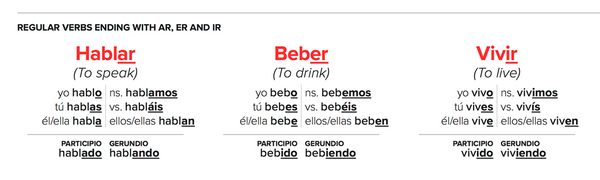
(The 3 patters of regular verb conjugations, -AR, -ER, and -IR)
On this poster, you'll find the full, present tense conjugations of 41 of the most used irregular verbs. For every verb, the forms of the verb which are irregular are highlighted in red. You'll also find 49 of the most used regular verbs, including a key to each of the 3 standard patterns for conjugating them. We've also included 5 more irregular verbs which are typically used reflexively (as in English, when we do something to ourselves. E.g. To dress). Finally, you'll find 5 more full, present tense conjugations for verbs which are typically used in the 3rd person. For example, in Spanish, you don't say "I like it" but rather "A mi, me gusta" (to me, it pleases me).
Along with each Spanish verb, you'll also find the English translation and the participio, which combines with the Spanish verb Haber to form the past perfect tense (used to describe an experience or something from the recent past, for example "I have seen the movie" or "I have eaten dinner"). Finally, you'll find the gerundio used to describe actions in progress (E.g. "I am eating," or "we are playing").
Finally, the verbs on this poster are arranged to make remembering them as easy as possible. Many irregular verbs still follow the same or similar patterns. Verbs that follow similar patterns are placed together on the poster.
Ships within 48 hours · Estimated delivery Jun 24 - Jun 29
US$40
Get nowSign up to your membership to get coupons up to
15%
Get nowOpportunity to enjoy order discount up to 15% off
Top-Converting Item to Boost Your Average Order


![Dissipation Field [Scars of Mirrodin]](https://cdn.shopify.com/s/files/1/0275/9661/9858/products/ba3e2fee-6125-5aca-b0b2-d1c5db0bb85c_ddef1ac4-5f85-4d38-915e-73c72c43a827.jpg?v=1636716490)


